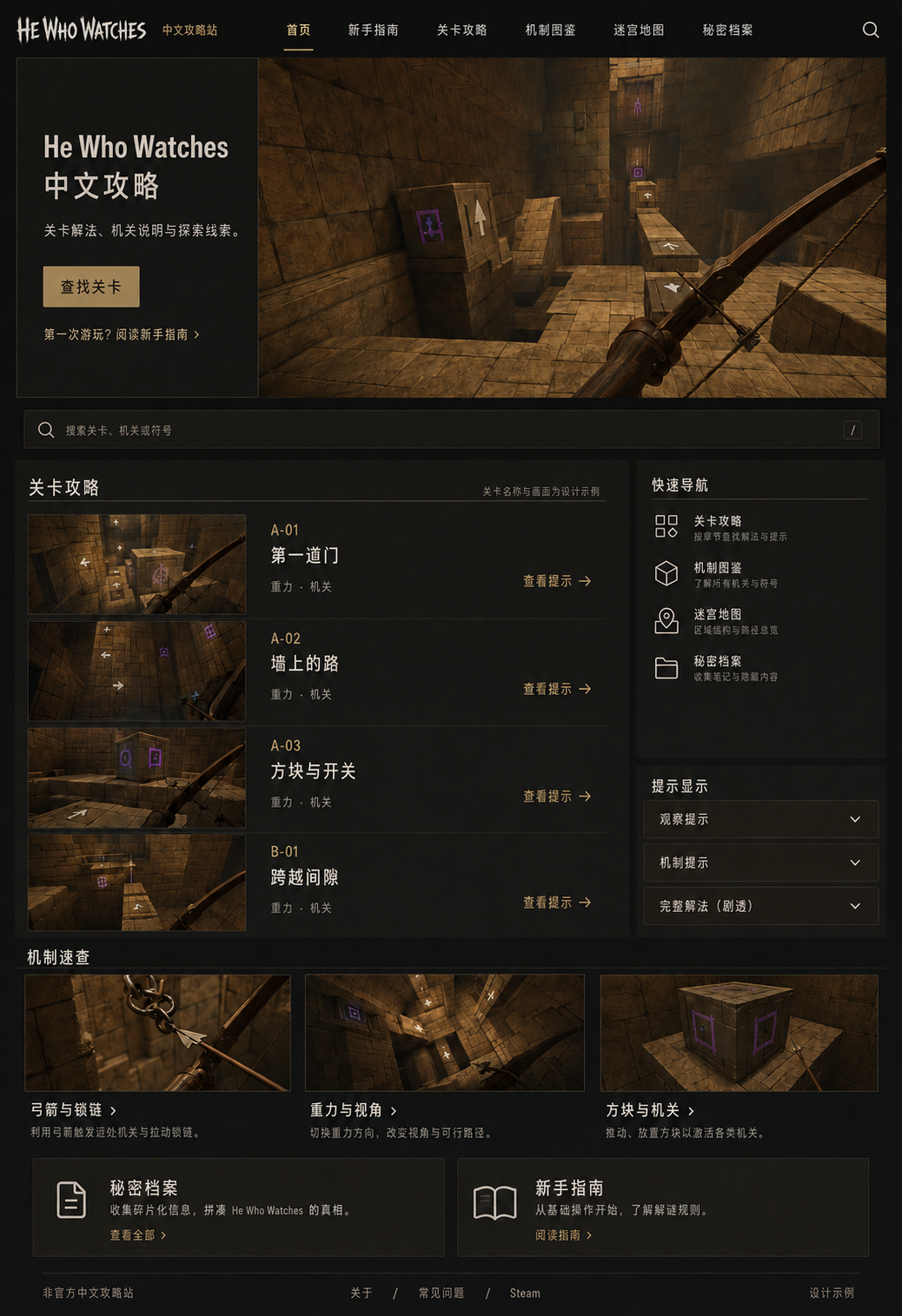
Beginner guide
Understand the controls, observation habits and the game's playable hints.
Concept illustration from the site design; not an in-game screenshot.
01Observe first
Survey geometry, interactions, states, and goals separately so a complex room becomes a sequence of testable questions.
The first layer is geometry: surfaces, connections, openings, and gaps. The second is interaction: elements that you have evidence can respond to an action. The third is state: which relevant conditions are currently present. The fourth is purpose: what those conditions might contribute to your goal. These layers should inform one another without being collapsed. A distinctive object belongs to the scene, but its visual prominence does not prove its role in the solution.
Read guide ↗02Bow, arrow and chain
Evaluate departure conditions, expected arrival, and the next useful action when planning chain-assisted traversal across gaps.
Break a proposed crossing into departure, interaction, arrival, and continuation. Departure describes where you begin and what access you currently have. Interaction identifies the target and the action you intend. Arrival describes the position you expect afterward. Continuation names the next useful thing you can do from there. If you can explain only the first two, you have a traversal experiment rather than a complete plan. That is acceptable, provided you know what the experiment should teach you.
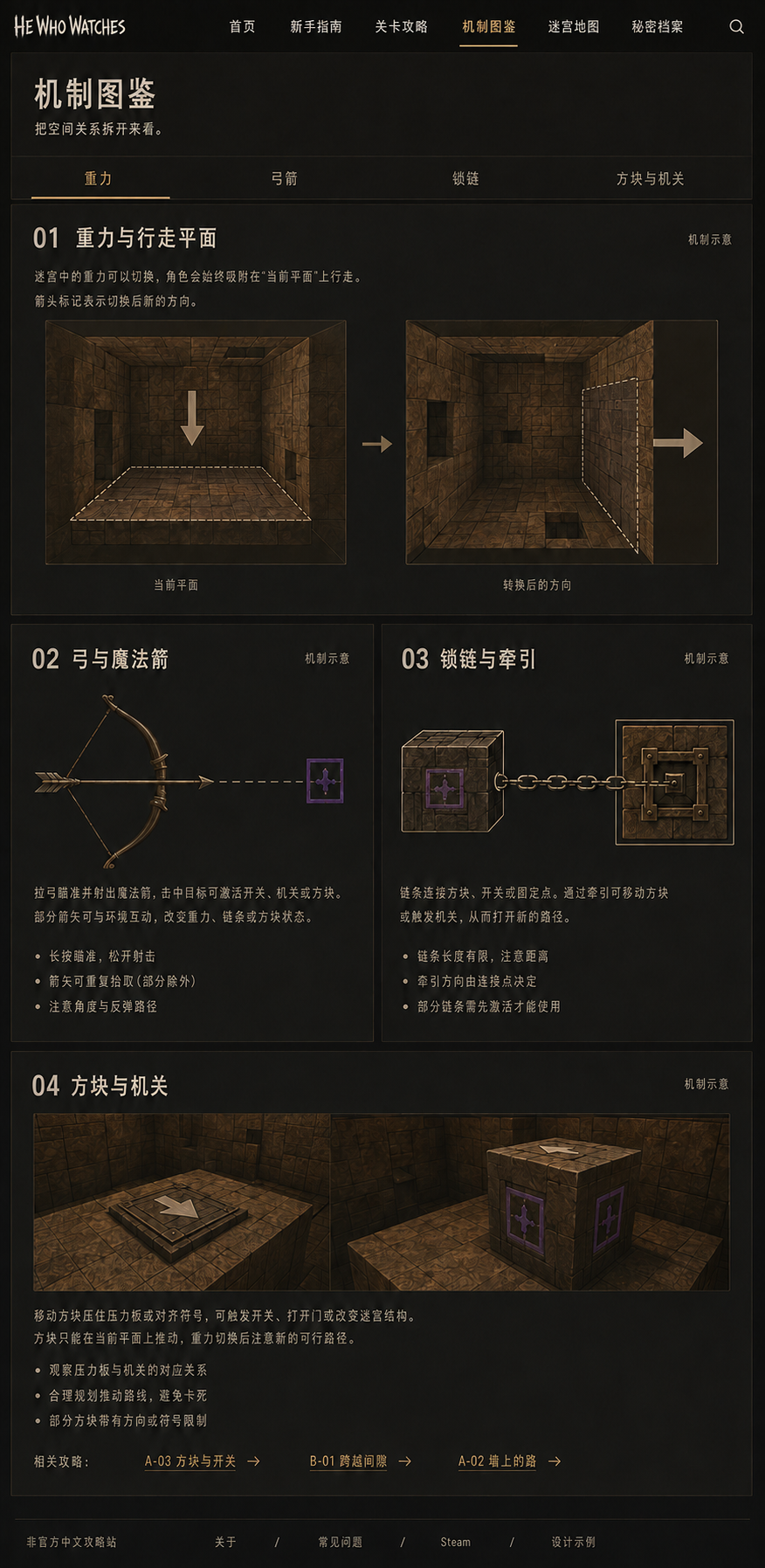
03Gravity and perspective
Keep landmarks and surface identities stable as your viewpoint changes, and diagnose spatial confusion through small, observable transitions.
There are three useful ways to describe a position. The room frame uses stable features such as the entrance and exit. The body frame uses your immediate forward direction and supporting surface. The task frame uses relationships relevant to a goal, such as the approach needed to reach a target. Confusion often starts when a statement silently changes frames. “The object is below” describes your current view, while “the object is beside the entrance” describes the room. Neither is wrong, but they answer different questions.
Common questions
Pray for guidance
Pray for guidance rooms are optional. The developer confirms that solving a main puzzle without its hint room does not miss separate content.
Read guide ↗Bow, arrow and chain
Look at the connection, the object it acts on and the space between them.
Read guide ↗Gravity and perspective
Compare the surfaces and the direction of motion before and after one action.
Read guide ↗