Based on the linked sources and original analysis. No first-hand playtesting is claimed.
A crossing needs a useful arrival
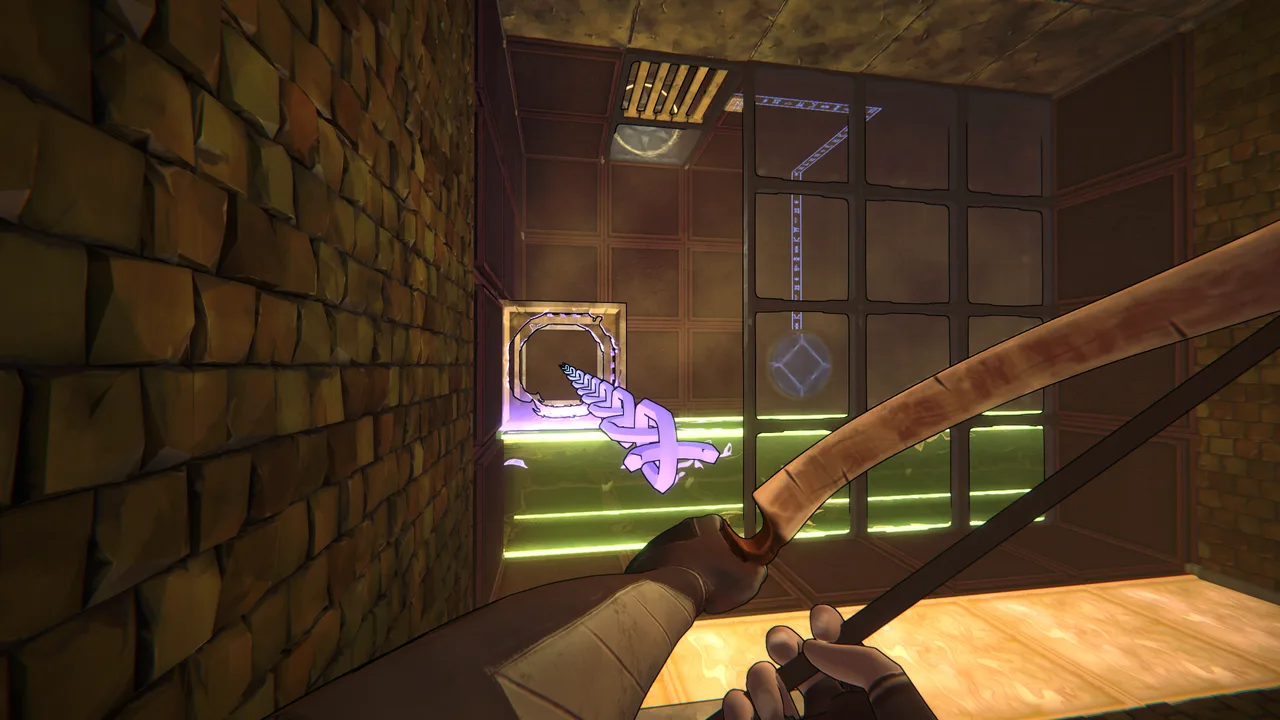
The official description says the magical chain can pull the player across gaps. That confirms a traversal use, but it does not establish every anchor rule, attachment condition, range limit, or recovery action. Plan around what your current room visibly permits. A successful crossing is only the first question. The more important question is whether the resulting position gives you the access or interaction needed next. Treat the arrival state as the purpose of the crossing, rather than treating motion across empty space as a solution by itself.
“Hookshot” is a convenient search term used here for that chain-assisted traversal idea, not a claim about the game's interface terminology. This guide offers original route planning and diagnosis without assigning buttons or inventing attachment mechanics. Its examples are hypothetical arrangements, not named-level instructions. When the chain behaves differently from your prediction, inspect your position, the target, and the result before assuming a hidden rule. The aim is to build a dependable explanation of a crossing and its consequences, using the actual prompts and behaviors you observe in your own version.
Describe the crossing as four states
Break a proposed crossing into departure, interaction, arrival, and continuation. Departure describes where you begin and what access you currently have. Interaction identifies the target and the action you intend. Arrival describes the position you expect afterward. Continuation names the next useful thing you can do from there. If you can explain only the first two, you have a traversal experiment rather than a complete plan. That is acceptable, provided you know what the experiment should teach you.
This four-state description exposes a common mistake: choosing a target because it is visible from the departure point without examining the destination relationship. Imagine arriving beside an important doorway but on an approach that does not permit entry. The crossing may have worked exactly as intended mechanically while the plan failed spatially. Preserving that distinction lets you reuse the confirmed part. You can now investigate another arrival relationship, a different prerequisite, or an altered order of actions instead of repeating the same crossing and hoping proximity will somehow become access.
Identify the target without assuming its function
A distinctive surface may look like a plausible traversal target, but appearance alone does not establish its behavior. Give it a neutral name based on location and inspect what the game teaches about interacting with it. If you are testing its role, make that the explicit question. Do not combine an unknown target with an unknown arrival and a complex sequence of object changes. Too many unknowns make an unexpected result difficult to interpret.
Before the test, note what would count as useful evidence. Perhaps you want to know whether an interaction is available from your present position or whether the resulting movement reaches a particular side of the room. Afterward, record only what you observed. A target responding once under one arrangement does not prove it responds from every approach. A target failing to respond does not prove it is irrelevant. Conditional descriptions keep your map flexible while giving you concrete knowledge. They also help when two visually similar targets turn out to occupy very different roles in the surrounding geometry.
Inspect the departure position
The departure position is not simply wherever you happen to stand when you notice a gap. It may determine the approach, your relationship to the target, and the arrangement you leave behind. Before attempting a crossing, identify your supporting surface and at least one stable landmark. Then ask whether the current position is necessary for another action you have not performed yet. Crossing too early can create an ordering problem even when the movement itself is available.
Consider an imaginary room where one useful interaction is accessible near the entrance and another lies beyond a gap. A natural impulse is to cross as soon as possible. A better question is whether the entrance-side interaction must happen before you leave. You do not have to assume that returning is impossible; you simply should not rely on a return route you have not established. Inspect available connections and use the game's actual recovery options if needed. The planning principle is to preserve required access consciously, rather than discovering its importance only after you have moved elsewhere.
Inspect the arrival before committing
Look at the area you expect to reach and identify a recognizable feature there. Ask what surface or position would support the next intended action. If the view is ambiguous, seek another available observation angle before crossing. A destination that looks spacious from afar may contain a relevant obstruction or a restrictive approach. The point is not to predict every detail perfectly. It is to replace “somewhere over there” with a specific state you can compare against the actual result.
Write an arrival sentence such as “I expect to reach a position beside the marked opening, with a view of the next target.” This statement is concrete enough to test without asserting unverified physics. After the crossing, compare both parts. You might arrive beside the opening while lacking the expected view. That result narrows the problem to the second relationship. If you instead describe success only as reaching the far side, you lose the distinction that would tell you why the continuation failed. Good arrival descriptions make partial success informative.
A route is more than a connection
Two areas being connected does not mean that every sequence through them serves your goal. A route includes the conditions under which the connection is usable and the state you carry into the next stage. If an object changes position before you cross, the departure or arrival relationship may differ from an earlier test. Keep those conditions in the record. Familiarity with a crossing can otherwise make you overlook a changed arrangement that explains a later surprise.
A concise route note might read “with the entrance approach clear, this interaction reaches the marked side.” The condition is valuable because it identifies what a later action must preserve. If your plan requires blocking that approach, you now have a dependency to resolve. Perhaps the crossing belongs earlier in the sequence; perhaps another path exists; perhaps the assumed purpose of the object is wrong. Do not jump directly to one answer. First recognize that the conflict is between two requirements. This turns a confusing traversal problem into a manageable ordering question.
Distinguish distance, alignment, and access
When a traversal attempt does not work as expected, several different issues can look alike. The target may not have the role you assumed, the approach may be unsuitable, the current interaction state may differ from your expectation, or some part of the route may be obstructed. Do not invent a numerical range limit to explain the failure unless the game provides one. A single unsuccessful attempt cannot establish which of these possibilities is responsible.
Change one relevant condition for the next test. If you suspect approach, use another available position while keeping the target identity clear. If you suspect obstruction, inspect the relationship between departure and target. If the intended input is uncertain, consult your current controls before interpreting another attempt. Record the result with its conditions. This method is deliberately conservative about conclusions while remaining active about experimentation. It lets you learn a useful boundary without converting a guess into a rule that will mislead you in later rooms.
Plan what remains behind
A crossing can change your access to the departure area even when it does not visibly change an object. Before leaving, identify any unfinished task on that side. Is there a target you still need to inspect? An object whose state matters? A route you are relying on without having checked? These questions help distinguish a necessary crossing from a premature one. You are not required to finish every possible interaction before moving; you are deciding which ones are dependencies of your current plan.
Use a simple classification: required before departure, optional information, and unrelated for now. The first category deserves attention. The second can be weighed against the value of the new viewpoint. The third should not delay you merely because it is visible. This keeps planning from becoming exhaustive surveying. A room can contain more detail than the current question needs. The useful habit is to account for access that matters while allowing uncertainty about details that have no demonstrated role yet. You can revise those categories if later evidence changes the plan.
Compare two possible crossings
If two traversal opportunities appear available, compare them by what each enables rather than by which looks shorter. One may arrive near the destination but offer poor information. Another may reach a recognizable position from which you can inspect several relationships. During learning, the second can be more useful even if it is not part of the eventual solution. Once you understand the room, you can reconsider efficiency. Exploration and execution have different priorities.
For each candidate, write the departure condition, expected arrival, new information, and next action. The comparison often reveals that the options are not interchangeable. One preserves access to an important target; the other creates a better approach to an object. You may discover that both are useful at different stages. This is more productive than choosing the visually direct route by instinct. It also makes failure easier to analyze: if an option does not provide the predicted advantage, you know exactly which part of the comparison needs revision.
Understand a failed continuation
Suppose the crossing occurs, but you cannot proceed. First identify whether the failure concerns position, object state, or an omitted prerequisite. Position means you arrived somewhere different from the relationship the plan required. Object state means the relevant element is not arranged as needed. An omitted prerequisite means the next action depended on something you never established. These categories can overlap, but separating them gives you a starting point for diagnosis.
Avoid treating the entire route as wrong immediately. If the crossing reliably reaches a known state, retain that knowledge. Then ask what must change before or after it. A useful failure note might say “arrival is confirmed; access to the next target is not.” That note is far more actionable than “chain route fails.” It tells you whether to inspect a different approach, reorder another action, or revise the intended destination. Puzzle progress often comes from keeping a confirmed transition while repairing the surrounding plan, rather than replacing every idea after each unsuccessful attempt.
Use landmarks during motion
If changing perspective makes crossings hard to read, choose an arrival landmark before initiating the action. Once movement resolves, locate it and identify your supporting surface. Do not immediately attempt the next interaction while still reconstructing where you are. The pause helps distinguish the intended arrival from a merely similar view. It also keeps a navigation misunderstanding from contaminating your interpretation of the next target's behavior.
You can practice this with a short, understood traversal opportunity rather than a complicated puzzle sequence. Predict the landmark's relationship, perform the available action, and compare. Repeat only if there is a specific uncertainty to resolve. The purpose is not to memorize an animation but to connect the before and after states. If camera presentation is the main obstacle, inspect the comfort settings actually available in your version and compare one change at a time. No particular setting name or guaranteed effect is assumed. Choose a presentation that helps you maintain a readable relationship between the two states.
Build a reversible learning mindset without assuming undo
Careful learning does not require a verified undo button, but it does require awareness of consequences. Before a consequential test, inspect the recovery or restart options the current game actually offers. If you do not know how to return to a useful state, choose an observation that changes less when possible. This is a planning preference, not a claim that the game permits permanent failure. The guide does not establish the existence or scope of manual undo or reset features.
When a test leaves you somewhere unexpected, stop and describe the new state before attempting recovery. It may be useful even if it differs from your plan. You might have discovered another approach or a better viewpoint. If recovery is necessary, follow the interface and preserve a short note of what the experiment taught. Repeating the same test without recording its result wastes the main benefit of experimentation. A recovery action should restore your ability to investigate, while the knowledge from the previous attempt remains available to guide the next one.
A hypothetical crossing worksheet
Imagine a marked target across a gap, an object near your departure area, and an exit beyond the expected arrival. Begin with the destination requirement: what position would permit the final approach? Then inspect whether the crossing appears to establish that position or merely reach its vicinity. Record the object's current role separately. Do not assume it must move just because it is present. Your first test might concern the arrival alone, provided you understand the available recovery options and consequences.
After observing the arrival, compare it with the exit requirement. If a mismatch remains, ask whether the object could affect that specific relationship, whether another departure position changes your approach, or whether another route is visible. Each is a hypothesis requiring evidence. The worksheet's strength is that it prevents the object, target, and exit from collapsing into a vague instruction to “use everything.” Every element earns a role through a demonstrated relationship. That makes the puzzle easier to explain and keeps speculative mechanics from entering your plan unnoticed.
Rate the information value of an arrival
An arrival can be valuable because it changes what you know, even when it is not the final route. Before an exploratory crossing, list the relationships you expect to inspect from the new position. Perhaps you will see the destination's approach more clearly or distinguish two surfaces that overlap in your current view. After arriving, check whether that information became available. If it did, record the finding before moving again. A new viewpoint is most useful when you preserve what it revealed rather than immediately pursuing another visible target.
If the arrival reveals less than expected, ask whether a small local observation would answer the original question. Do not automatically add another crossing, because that may replace one uncertain state with two. The point is to evaluate exploration by its evidence. You can learn that a viewpoint does not resolve a particular ambiguity, which helps you choose a different observation route later. This approach also separates two kinds of success: traversal success and investigative success. A crossing may work physically while failing to supply the information you wanted, and recognizing that distinction prevents you from repeatedly visiting the same unhelpful viewpoint without a clearer purpose.
The checklist before you cross
Confirm the identity of the target, the current departure position, the expected arrival relationship, the next useful action, and any required access you are leaving behind. If you cannot answer one of those points, decide whether the crossing is meant to resolve it. An exploratory crossing is reasonable when its information value is clear. A crossing chosen only because it is available may still teach something, but it will be harder to interpret if you have not preserved a baseline.
Chain-assisted traversal becomes easier to reason about when you stop treating the gap as the whole problem. The route begins with a useful departure state and ends with a useful continuation. Keep those endpoints explicit, describe findings conditionally, and separate a confirmed crossing from an incomplete larger plan. Consult current prompts for actual actions and avoid importing assumptions from other hookshot-style games. Your goal is a route you can explain: why you leave from that position, what the interaction establishes, and how the arrival contributes to the next requirement.
| Focus | What to record | Practical response |
|---|---|---|
| Departure | Current access and supporting surface | Is unfinished work on this side required? |
| Interaction | Identified target and observed availability | Am I testing a known relationship or a new one? |
| Arrival | Expected position beside a landmark | Does the result match the useful approach? |
| Continuation | The next action from that state | What prerequisite still needs to be established? |