- 01Start with the symbol rather than the cube
- 02Build a face inventory
- 03Distinguish the image from its surrounding frame
- 04Read each stage as a new instruction
Based on the linked sources and original analysis. No first-hand playtesting is claimed.
Hint levels
01The reported method
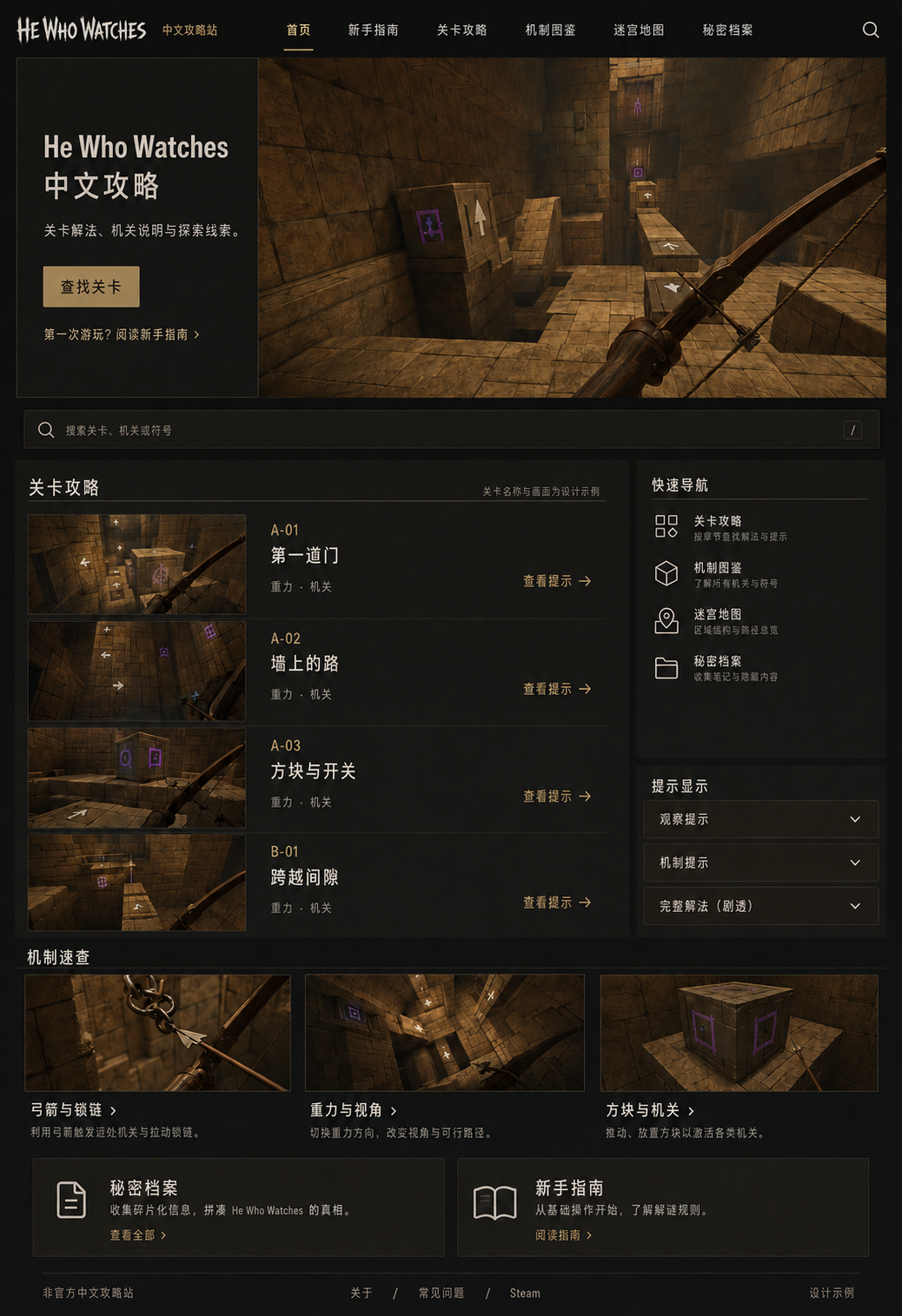
The community torch guide describes a symbol above the Chamber of Transport torch and different images on the faces of a central cube. Its method is to look at the cube face that corresponds to the displayed symbol, then read the new cue and repeat. The account includes the cube's upper and lower faces and warns that an error restarts the sequence.
This is a player-reported solution, not an independently tested procedure. The developer separately identifies Transport as the easiest torch to execute, but that statement does not certify every detail of the community guide. Keep the two sources distinct: the developer recommends the target, while the player guide supplies the specific matching method.
No fixed input sequence, number of stages or exact camera path is established here. The useful answer is a responsive process: read the cue, identify its matching face, look at that face and inspect what changes. The following sections explain how to make that process legible and how to investigate failures without inventing missing controls or prerequisites.
02Start with the symbol rather than the cube
The cue above the torch is the starting reference in the reported method. Before turning toward a cube face, describe what you see there. If several images share an outline or motif, note the distinctive internal feature that separates this one from the others. A vague memory of an eye-like image can make different cues easy to confuse.
You can give each symbol a private descriptive label based on its appearance. The label does not need to decode the game's language or name the image officially. It only needs to help you distinguish one cue from another consistently. Avoid assigning a meaning you have not established, because a speculative translation can distract from a straightforward visual correspondence.
Then look for the matching image on the cube. This order matters as a reasoning discipline: it prevents you from choosing a convenient face first and deciding afterward that it resembles the instruction. Treat the displayed cue as the question and the face selection as your proposed answer.
03Build a face inventory
A cube has six faces, and the community account explicitly includes the top and bottom. An inventory limited to the four faces most obvious from one view can therefore be incomplete. Before beginning a serious sequence attempt, identify which images you have actually observed and which faces remain unexamined.
Make a short list of face descriptions tied to the images rather than to temporary screen positions. If you call an image the left one, that name may become misleading after you move. Calling it by a distinctive visible feature preserves the match even when its location relative to your camera changes.
This inventory is an observation exercise, not a verified route around the cube. The source does not provide exact positions from which every face should be viewed, and this article does not invent them. Use the surfaces and sightlines available in your own state to inspect the cube, keeping a clear distinction between an image you have seen and one you have merely assumed must be present.
Open the guide · contains spoilers
Distinguish the image from its surrounding frame
The community description refers to images associated with the cube's eyes. When comparing a cue with a face, focus on the detail that actually distinguishes the candidate faces. If you compare only a shared outer shape, several choices may appear correct. The purpose of the inventory is to identify the discriminating feature rather than the common decoration.
Do not assume that a similar-looking motif proves a match. Compare proportions, internal marks or whatever visible detail separates the images in your game. This article cannot supply a verified symbol chart, so your observation must do that work. A careful comparison is preferable to a confidently named image that was never actually inspected.
If a face is partially obscured or viewed at an awkward angle, mark the identification as uncertain. Do not let a guess become the foundation for an entire sequence. Resolve the uncertainty when practical, then return to the cue. The method is about correspondence, and a poor visual identification can make a correct overall idea appear unreliable.
Read each stage as a new instruction
The guide says the cue changes as you progress. Therefore, do not assume that the next face is determined by a fixed spatial pattern such as moving clockwise around the cube. The reported process requires inspecting the current instruction after each successful-looking response. A sequence can be orderly without being a simple tour of adjacent faces.
Pause conceptually between stages. Record the cue you answered, the face you chose and the cue you now see. You do not need a lengthy journal; a few short labels can be enough. The pause is a way of keeping state clear, not a claim that the game requires a delay or has a particular timing window.
If the cue remains visually similar, compare it carefully rather than assuming no progress occurred. It could be the same-looking observation, a misread change or an unsuccessful response. The source does not establish a complete feedback specification. Treat what you see as evidence to interpret, and avoid advancing your mental stage counter without a reason.
A practical attempt structure
First, identify the symbol currently displayed above the torch. Second, choose the cube image that you believe corresponds to it. Third, look toward that face as the community method describes. Fourth, inspect the torch cue again before deciding what to do next. This is the reported loop expressed in functional terms, not a list of guaranteed camera inputs.
Keep your note about the selected image separate from the route you took to view it. If an attempt fails, that separation helps distinguish a wrong match from an uncertainty about execution. You may have correctly identified the face but not understood what the game registered, or you may have executed an incorrect selection clearly. Those cases deserve different investigations.
Repeat only with the newly observed cue. The source warns of resets after mistakes, so an unverified assumption about progress can contaminate every later selection. Confirm the state as well as you can from the visible response. When in doubt, return to observation rather than guessing the next part of an imagined sequence.
What a reset does and does not tell you
A restart, if that is what you observe, indicates that the attempt did not satisfy the sequence as intended. It does not automatically tell you which assumption was wrong. The visual match, the selected face, the interpretation of the current cue or the execution may need review. Record the last clearly understood stage before changing your approach.
The community guide's warning is useful, but this article cannot establish the exact visual signature of every reset. Do not label any unchanged symbol a reset without checking. Likewise, do not assume that the return of a familiar image proves you have reached a new stage. Your notes should track observed cues and responses rather than inferred progress alone.
After an ambiguous attempt, reread the current display as a fresh instruction. Avoid continuing from the stage you hoped to reach. A state-based method is resilient because it uses the scene's current cue, while a memorized sequence can drift away from the actual puzzle after one unnoticed mistake.
When no visible side matches
First check whether your face inventory is complete. The top and bottom are specifically mentioned in the reported method. A cue with no match among the four familiar sides may point toward one of the faces you have not examined. That is a concrete reason to broaden observation before abandoning the matching idea.
Next check the quality of your descriptions. Two images that looked identical at a glance may have a distinguishing mark. If your notes reduce both to the same vague label, the inventory has lost information. Reinspect the candidates and use a description that preserves the difference you can actually see.
Finally, keep open the possibility that you have identified the wrong local feature or chamber. This article addresses the Transport torch described by the community guide. Similar symbols elsewhere do not establish the same interaction. Verify the room and the relationship between the torch cue and central cube before trying to force every observation into this method.
When a seemingly correct match does nothing
Separate confidence in the match from confidence in the interaction. Are you sure the selected face carries the same image as the cue? Are you sure you are observing the intended face clearly? Did you inspect the cue afterward rather than assuming an immediate dramatic effect? These questions help isolate the uncertain part without inventing an extra action.
The source describes looking at the corresponding face. It does not establish a required click, shot, prolonged hold or exact reticle placement. This guide therefore does not prescribe those as facts. If you experiment with execution details, label them as tests and change one meaningful variable at a time.
Also check whether you were following the current cue or a remembered one. A correct image for the previous stage may be wrong for the present state. This is why the read-select-observe loop matters. It keeps a visually accurate match tied to the instruction that is actually being displayed.
Use image labels that survive movement
Suppose you initially call the visible faces left, front and right. After moving around the cube, those labels may refer to different physical faces, even though your notes still use the same words. That can create a silent mismatch between the image you intended and the face you chose.
Use image-based labels as the primary identifiers and directions only as temporary navigation notes. If an image has a distinctive line or shape, describe that feature. The exact labels are personal, but they should be mutually distinguishable. Avoid official-sounding names unless a source or the game actually supplies them.
For a longer attempt, keep a tiny legend that associates each observed image with its current physical face. Update directional notes when your viewpoint changes. The symbol identity should remain stable. This method reduces orientation errors without claiming that the cube rotates, that the images change places or that any unobserved mechanic is involved.
A matching exercise away from the controls
Draw a rough set of the six image descriptions you have observed, or write six distinguishable labels. Then point to a recorded cue and select its counterpart without thinking about movement. This separates the visual recognition task from the navigation or camera task. If the match itself is uncertain, practicing execution will not solve the identification problem.
Once the correspondence is clear, return to the game and ask how to view that specific face from your present position. Now the spatial problem has a defined target. You are no longer searching for a symbol and deciding how to approach it at the same time.
The exercise is optional and should stay small. It is not a substitute for observing the current cue, and it does not produce a universal solution sequence. Its value lies in reducing the number of simultaneous uncertainties during an attempt, especially when similar images or changing viewpoints make it easy to lose track.
Keep a sequence record that helps diagnosis
Use one line per stage with the cue label, selected image and observed result. If the result is unclear, write unclear. Do not automatically number it as a successful stage. A compact record can reveal whether a particular match repeatedly causes trouble or whether the uncertainty begins when you stop checking the cue.
Keep the route to the face in a separate note only if it matters for your execution. Mixing route directions into the symbol record can make the sequence difficult to compare across attempts with different viewpoints. The essential record is about correspondence and response.
If you notice repeated success up to a certain point, inspect the next selection first. Preserve the reliable prefix as an observation without claiming the full sequence is fixed or universal. The source does not establish whether every session presents an identical ordering. Reading the current cue remains safer than treating a remembered prefix as a rule that overrides the display.
What to do after a successful activation
Record what you actually observed and the local method that produced it. Avoid immediately inferring a complete reward chain or a universal rule for other torches. The developer says the torch solutions differ, so Transport should be understood as its own solved correspondence rather than a template to impose everywhere.
If another part of the scene changes, note it separately. You may later establish a connection, but chronology alone is not proof of its full meaning. Keeping local activation and broader interpretation distinct makes your notes more useful for future secret exploration.
The transferable lesson is the process: read a cue, identify its reference, perform a deliberate response and inspect feedback. Another chamber may use an entirely different action. Carry the observation discipline forward while leaving the specific face-matching method attached to the puzzle for which it was reported.
Distinguish recognition errors from memory errors
A recognition error happens when two different images appear equivalent to you. A memory error happens when you correctly recognized the cue but later act on an earlier or inaccurately remembered one. They can produce the same failed selection, yet their remedies differ. Reinspect distinguishing features for the first; shorten the interval between reading and responding for the second.
You do not need to rush. The point is to keep the current instruction explicit while planning how to view its counterpart. A short label written before movement can be enough. If you repeatedly change your mind about the symbol while traveling, return to the cue and settle the identification rather than carrying uncertainty into the next response. This keeps the experiment focused on one known target instead of several possible targets competing in memory.
Source confidence and limits
The community guide supplies the face-matching account, inclusion of upper and lower faces, changing cues and reset warning. The developer supplies the separate recommendation that Transport is an easy torch to execute and the broader statement about distinct local solutions. Neither source gives this article an independently observed input transcript.
Accordingly, there is no invented fixed sequence here and no claim of complete secret progression. The diagnostic exercises are original analysis designed to help you apply the reported method carefully. They keep image identification, orientation, interaction and state tracking separate so that a failed attempt can reveal something specific.
Use the guide as a responsive investigation. Read what is displayed now, select the matching observed face, and check the result before proceeding. That is both the most direct interpretation of the available community account and the clearest way to avoid losing the sequence through an unnoticed assumption.