Based on the linked sources and original analysis. No first-hand playtesting is claimed.
Hint levels
01The answer before the spoilers
Torch puzzles have different solutions. The developer says to look for unusual features in the hubs containing them, identifies the Chamber of Transport torch as the easiest to execute, and says lighting torches is not about wisps. A separate developer reply confirms that garden routes have an intended solution rather than requiring brute force, and points toward the outlines of chambers on the map.
These are clues to begin an investigation, not a complete torch checklist. Community reports offer more specific ideas for several chambers, but the available guide is incomplete and includes uncertain comments. This article separates the developer's statements from those reports. It does not claim that every torch, garden path, prerequisite or secret ending has been independently verified.
For a low-spoiler starting point, choose one hub with a torch and inspect what makes its surroundings distinctive. If you want a concrete first target, Transport is the developer's recommendation for ease of execution. Stop before the chamber-specific sections if you want to preserve the individual solutions. The later analysis explains how to test clues carefully without confusing guesses with confirmed rules.
02Do not assume every torch shares one action
03Separate wisps from torch activation
In the torch discussion, the developer rejects the idea that lighting them has to do with wisps. That directly addresses a player's speculation. It is a stronger source than an uncertain later comment describing one successful-looking event while also wondering whether a collected wisp mattered.
The practical implication is not that wisps are irrelevant to every secret in the game. Keep the statement within its context: do not make wisp collection your assumed torch-activation requirement. A broad claim about all late-game progression would go beyond the evidence. Likewise, the developer's reply does not document every relationship among all optional systems.
If an experiment happens to follow a wisp collection, avoid attributing success to the collection merely because it came first. Compare what you actually changed at the torch. A local action, a different position or a completed pattern may be the relevant event. Keeping these possibilities separate prevents a coincidental sequence from becoming a misleading prerequisite in your notes.
Open the guide · contains spoilers
A first inspection routine
Start by describing the area around the torch without trying to solve it. What symbols are nearby? Which objects differ from ordinary scenery? Are there surfaces that seem deliberately marked? Are there repeated elements that could be compared? These questions are an original observation routine, not an official list of required clues.
Then identify possible relationships. A symbol near the torch might correspond to a symbol elsewhere. A group of markings might form a set. A spatial pattern might represent a route. Keep several interpretations alive until an interaction or a clearer visual match supports one. The goal is to narrow the possibilities through evidence, not to treat every decorative detail as a hidden switch.
Finally, choose one small test. A useful test should reveal whether your proposed relationship matters, rather than changing many objects and viewpoints at once. Record what you expected and what changed. If nothing changes, do not immediately conclude that the clue is irrelevant; check whether you actually performed the proposed action under the conditions you intended.
Why Transport is a sensible first investigation
The developer calls Transport the easiest torch to execute. That is a recommendation about a starting target, not a promise that every player will decode it immediately or that its solution teaches all the others. It can still be useful because a first completed torch may make the broader idea of reading local clues less abstract.
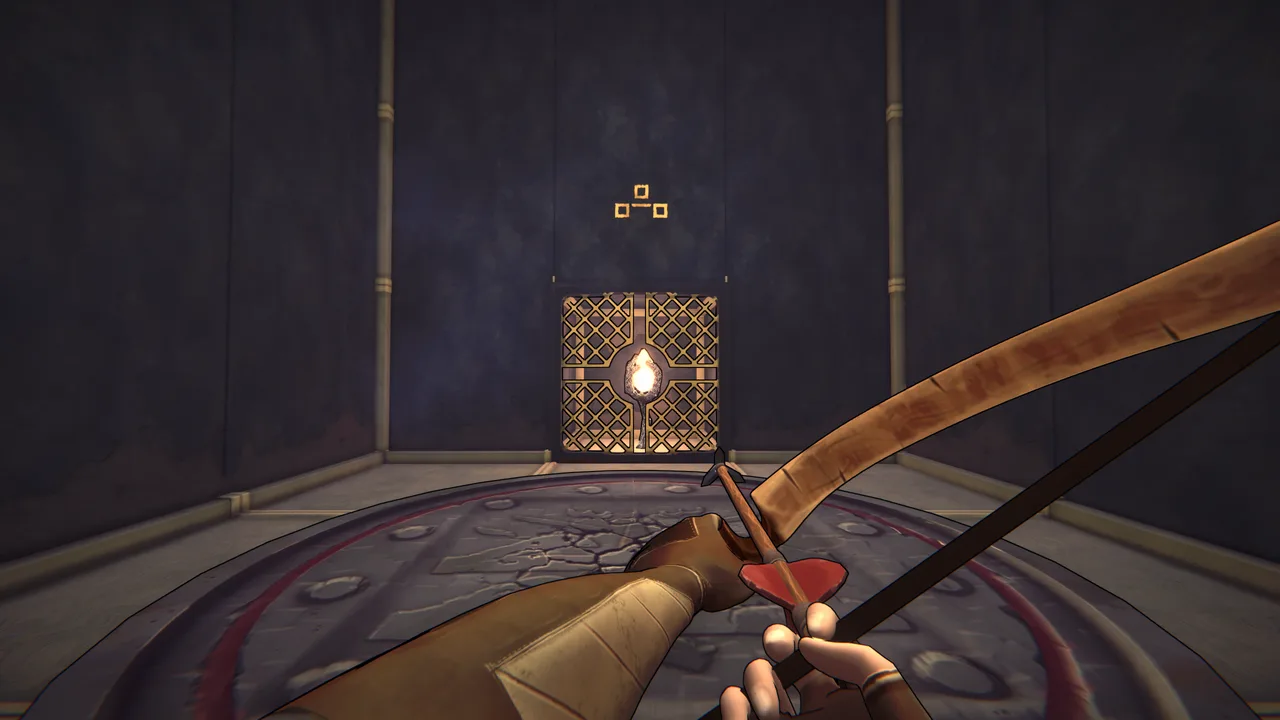
A community guide describes a correspondence between the symbol above the torch and images on the faces of a central cube. Its reported method involves looking at the matching face, including top and bottom, then responding to the changing cue. That account has not been independently tested here, and it should be cited as a player guide rather than merged into the developer's official hint.
If you use that method, focus on observing the cue after each action. Do not assume there is one universal sequence this article can print without inspecting the current display. The practical work is matching a visible instruction to a visible face and checking the response, not copying an invented series of directions.
What is reported for Rigidity
The community torch guide says the Chamber of Rigidity contains four eye markings that need to be covered. A comment adds that different block types can serve this purpose. These are useful leads, but neither statement comes with independent verification in this article or a complete documented route to every required object.
The same comment discussion includes a player who could identify only three ordinary blocks and found that standing on another eye did not seem sufficient. That report should not be converted into a universal prohibition on every possible player interaction. It describes one person's unsuccessful test. Its stronger editorial use is to show why counting only the most obvious objects may leave the proposed method incomplete.
For practical investigation, identify the four candidate eyes and track which are covered by the objects you can actually manipulate. Keep the inventory tied to observed availability. Do not invent a fourth block location or assume that an object is useless solely because it differs visually from the others. The community comment suggests checking object function, but the live scene must establish the details.
What is reported for Stability
A comment on the community guide interprets the tops of pillars in the central room as pieces of a route map, described as seven by eight. The proposed solution is to follow valid paths through the corresponding room, using blocks and wall walking to negotiate obstacles. This is a community account, not a developer-confirmed diagram or a route reproduced by this article.
A different player in the torch discussion had arranged marked stones and found a pattern that did not seem to work. That failed arrangement should not be published as the answer. The contrast is useful because assembling a recognizable image and correctly interpreting its relationship to a room are separate tasks. A plausible map can still be misoriented or assigned to the wrong reference frame.
If you investigate this lead, first distinguish transcription from navigation. Record the markings accurately, then determine how the resulting pattern relates to landmarks in the actual room. Avoid treating the dimensions alone as enough to establish orientation. This guide does not supply the complete map or certify a particular starting square.
Why the Flow comment needs extra caution
One commenter describes being crushed by a block while standing on a cracked seal near a torch in a chamber they call Flow. The same comment explicitly says the exact unlock requirements are uncertain and wonders whether a previously collected wisp mattered. That is an incomplete report, not a settled recipe.
The developer's broader torch reply says wisps are not the basis of torch activation. Therefore, do not repeat the comment's wisp speculation as a requirement. It remains possible that the commenter misidentified the relevant condition or simply included an unrelated fact about their session. The available evidence is insufficient to turn the whole event into a verified solution.
This article also does not merge Flow with Streams automatically. Community naming can be inconsistent, and the sources here do not settle whether those labels refer to the same place. If you pursue the lead, verify the room name shown in your game and the exact local feature before applying advice from another location.
Garden clues are connected questions, not a brute-force mandate
The garden discussion establishes two narrow points: there is an intended way to find the routes, and the map's chamber outlines matter. It does not provide every garden path or a complete mapping between torches and gardens. Use the clue to inspect the map, not to claim that any specific outline is already decoded.
Separate observing a shape from interpreting its use. First, identify which outline belongs to the chamber you are studying. Then ask what information its shape could convey in relation to the local scene. If you cannot explain the correspondence, keep it as a hypothesis. A pattern that resembles a route is a starting point for reasoning, not proof of the route.
Brute force may produce an outcome without explaining the intended relationship. If your aim is to understand the puzzle, a more useful approach is to preserve observations and test a coherent interpretation. The developer's hint gives you a reason to look for that interpretation rather than assume exhaustive trial and error is the only designed path.
Keep a clue ledger with three columns
Use a short ledger headed observed, proposed meaning and test. An entry might describe a symbol near a torch, propose that it matches another object, and identify an action that would distinguish that reading. The format helps prevent an interpretation from being remembered later as something the game explicitly told you.
After a test, add the result in ordinary language. The cue changed, a torch lit, or nothing visible happened are stronger notes than correct or wrong without context. If the result is ambiguous, record the ambiguity. You do not need to force every experiment into a decisive conclusion.
This is particularly important when several secret systems occupy the same hub. A change elsewhere may follow your action without establishing the relationship you intended to test. Track the specific feature you were observing. The ledger should help you build a causal explanation, not merely a chronology of interesting events.
Control the size of an experiment
Change one meaningful part of the setup when possible. If you move several objects, turn through multiple views and perform different interactions before checking the torch, success will be difficult to attribute. You may solve the local puzzle but remain unable to explain or repeat the result.
A small experiment can still be useful when it does not light the torch. It may establish that a symbol updates, that an object can cover a marking, or that a proposed reference frame does not match the room. These observations reduce uncertainty. Treating only complete activation as progress can hide the information gained along the way.
At the same time, do not make the experiment so narrow that it no longer tests the hypothesis. If your proposed rule concerns a complete set of four markings, covering only one may not produce visible feedback. In that case, track the setup carefully and evaluate the full condition rather than interpreting silence after one piece as disproof.
Manage spoilers by question, not just by label
Before opening a detailed secret guide, decide what you want answered. Do you need a starting location, a confirmation that a symbol is relevant, the interaction type, or a complete solution? Those are different spoiler levels. A broad search can reveal much more than the narrow uncertainty that brought you there.
For torches, the developer's local-feature hint is a low-detail starting point. The community method for an individual chamber reveals more. A late-game meta guide may reveal connections far beyond torch activation. Choose the source that matches the question rather than assuming all secret guides are interchangeable.
This overview deliberately omits a complete ending sequence, an all-torch route and a full language chart. None was established as independently verified in the research used here. You can use the known clues to investigate one chamber at a time without accepting an unsupported promise of total completion.
When a convincing pattern does nothing
Check identification first. Are you at the intended chamber and feature? Check transcription next. Did you record the pattern accurately, including orientation? Then check execution. Did the action actually satisfy the rule you proposed? These checks address different ways a promising interpretation can fail.
Only after those checks should you reconsider the interpretation itself. A pattern may be decorative, may refer to another part of the hub, or may require a different interaction. The developer's advice to seek unusual features does not establish that every unusual feature directly activates the nearest torch. Keep the relationship provisional until evidence supports it.
Do not repair an uncertain theory by adding an unverified prerequisite whenever a test fails. That makes the theory difficult to disprove and can lead to unnecessary collection tasks. Prefer a simpler explanation that accounts for both successful and unsuccessful observations. If the evidence remains inconclusive, label the lead unresolved.
A grounded starting plan
Begin with Transport if you want the developer's suggested easy execution target, or inspect the unusual features of a torch hub you already understand well. Keep wisps out of your assumed activation requirements. Use the chamber-specific community reports as leads, and verify their local relationships in your own view.
For garden questions, return to the map outlines rather than assuming brute force is mandatory. For uncertain reports such as Flow, preserve the uncertainty instead of turning a single event into a universal rule. For every chamber, distinguish a completed local experiment from claims about the game's entire secret progression. Keep a separate record for each location, including its displayed name, so that an observation from one hub does not quietly become an assumption about another. This matters especially when similar imagery encourages you to combine distinct puzzles before their relationships are understood.
The available evidence supports a careful exploration guide, not an exhaustive verified secret route. Its practical value is in narrowing the search: local clues, different solutions, explicit observation and modest tests. That approach respects both the game's discovery and the limits of what the current sources actually establish.