Based on the linked sources and original analysis. No first-hand playtesting is claimed.
Start with the condition you need
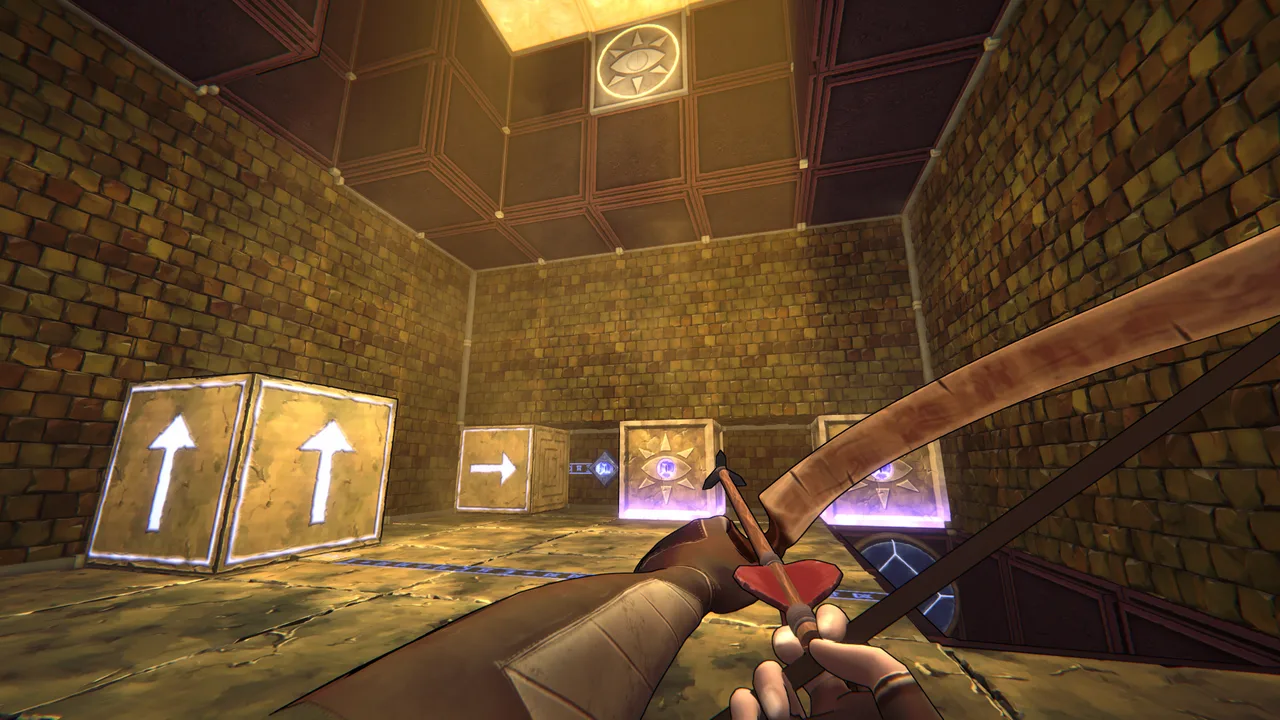
The official game description confirms that the bow can move blocks and activate switches. That establishes their importance, but it does not make every block or switch interchangeable. Begin by identifying the condition required for your next useful action. You may need access, a particular approach, or an object in a helpful relationship to a route. Then ask which visible element could establish that condition. Moving the nearest block because it is movable is an experiment; it becomes a plan only when you can explain what its new state would enable.
The detailed methods below are original planning strategies rather than an exhaustive mechanical manual. Historical coverage described additional interactions, but those observations should not be promoted into universal current rules without verification. This guide therefore avoids asserting exact stacking, attachment, pressure, or release behavior for every object. Use the teaching and feedback in your own room to establish those facts. Hypothetical examples are clearly about reasoning, not named solutions. The objective is to help you interpret consequences, preserve access, and identify ordering conflicts without inventing mechanics or assuming a manual undo feature exists.
Give each element a neutral identity
Name objects by location or a stable visual distinction before naming them by purpose. “Entrance block” remains identifiable after it moves if you consistently use that name. “Door holder” assumes a function you may not have established. Likewise, call a target “marked switch” rather than “final switch” until its role is clear. Neutral names keep your notes from embedding conclusions. They also make it easier to compare different hypotheses about the same element without unconsciously changing what you mean.
For each named element, maintain three short entries: observed state, observed effect, and untested idea. An observed state might concern position or visible activation. An effect records what changed after a particular action. An idea predicts a possible role in the solution. These entries should not merge. If you believe an object could preserve access, leave that as an idea until the relationship is demonstrated. This discipline is especially useful in rooms with several similar elements, where a remembered effect can accidentally be assigned to the wrong target or carried over from a different starting arrangement.
Separate access conditions from object goals
A block being in a particular position is usually meaningful because of what that position permits. Write that purpose explicitly. “Object beside the opening” describes a state; “this state leaves an approach to the target available” describes its value. If you cannot connect the placement to a requirement, you may be pursuing a visually plausible arrangement that does not advance the actual problem. This is a common source of long experiments that feel close to a solution but never produce a clear next step.
Read the destination backward and list its immediate prerequisites. Then identify which prerequisites depend on objects and which depend on your own position. A doorway could be accessible in principle while you lack a route to it. A target could be reachable while the object it affects is not ready for the intended consequence. Keeping these requirements separate prevents you from declaring success too early. A useful placement is one part of a combined state, and the rest of that state deserves the same attention as the object you just moved.
Test switch behavior under controlled conditions
When learning what a switch does, observe the relevant room state before and after the interaction. Identify the element you expect to change and whether your current viewpoint lets you see it. If an effect is hidden, do not assume there was none. Consider another available position or make a concise before-and-after record. Repeating the interaction without changing your observation plan may preserve the same uncertainty, especially when the apparent target and affected element are far apart.
Do not generalize a switch's persistence from appearance alone. Establish what happens under the conditions your plan will use. If the effect depends on an arrangement, record that arrangement. If you have not tested whether the effect remains after another action, mark persistence as unknown. This is not an instruction to exhaustively test every combination. Test the condition that matters to your next step. A narrow question such as whether access remains available after you change position can be more valuable than a broad attempt to classify every switch in the room.
Build a dependency list
A dependency list states what must be true before an action becomes useful or available. For each planned action, write its prerequisites and consequences in plain language. For example, an imagined action might require access to a certain side of an object and might create a route while blocking another approach. These are conditional descriptions to verify, not assumed mechanics. Once you list several actions this way, the source of an ordering problem often becomes visible.
Suppose action A creates the position needed for action B, but action B removes access required for action C. The puzzle is no longer an undifferentiated collection of blocks and switches. You have a specific conflict to investigate. Perhaps C belongs earlier, perhaps a different approach can satisfy its prerequisite, or perhaps your model of B is incomplete. Write the alternatives before choosing one. This prevents you from repeatedly executing A and B simply because they are familiar, then discovering the same missing condition at C without learning anything new.
Distinguish useful obstruction from accidental obstruction
An object can obstruct an approach you need, but obstruction is not automatically a mistake. In a spatial puzzle, the significance of a blocked space depends on the goal and the verified rules. The reasoning task is to ask which routes and interactions become unavailable and whether that change serves a purpose. Avoid assigning a global judgment such as “bad position” to an object state without specifying what it prevents or enables.
A good note says “this placement blocks my current route to the marked target.” That remains compatible with the possibility that the placement is useful later, after the target's role is complete, or from another approach. A vague note says “never put it here,” which can eliminate a necessary idea prematurely. Conditional thinking preserves options. It also helps you recognize sequencing opportunities: a state that is harmful early may be harmless or helpful after another requirement is satisfied. The order of conditions matters as much as the final arrangement.
Track your position as part of every move
Block planning often fails because the player mentally moves the object while leaving themselves in an imaginary convenient position. After predicting an object change, ask where you will actually be and how you will reach the next interaction. Your route may pass through a space that is no longer available. Your new orientation may change which approach is useful. The object state and player state belong in the same plan, even though you should record them separately to avoid confusion.
Try narrating a proposed sequence with both subjects: “the object reaches this relationship; I remain on this named surface; my next approach is through this available connection.” If any part is uncertain, mark it as the next question. This method catches plans that work only in a detached overhead imagination. First-person spatial puzzles require an executable route between interactions. You do not need to visualize every camera angle, but you do need to account for how the position needed for the next action will be established.
Use a minimal experiment for unfamiliar interactions
If two objects might interact, isolate the question as much as the room allows. Record their current relationship and predict one observable result. Avoid mixing the test with a switch activation and an orientation change unless those conditions are necessary to the question. The purpose is to determine which change caused which consequence. A spectacular result is not especially helpful if you cannot explain its cause or reproduce the relevant starting conditions.
After the test, describe the result without immediately naming a universal mechanic. You may observe that the objects move together in that arrangement, or that changing one affects their relationship. Those observations can support a more general rule later, but the initial record should remain precise. This is particularly important when relying on older guides, which may discuss mechanics from a preview build. Your current observation is the relevant evidence for your plan. Use historical descriptions as prompts for questions, not as permission to ignore a contradictory result in the installed game.
Diagnose apparent contradictions
When a familiar interaction behaves differently, compare starting conditions before concluding that the rule is inconsistent. Did the object's relationship to a surface differ? Did another object occupy a relevant position? Were you approaching from the same place? Was a switch in the same observed state? A difference that looked decorative at first may be important. The right response is to identify the smallest meaningful change between the two attempts.
Create a contrast note with two rows: expected case and surprising case. Record only the conditions relevant to the interaction, then circle the differences. If you cannot identify any, your observation may be incomplete or the issue may need outside help. Do not fill the gap with an invented rule merely to make the story feel coherent. A precise report of uncertainty is useful. “I observed different outcomes under these apparently similar conditions” gives you a basis for a focused test or a clear question to the community, without overstating what you know.
Separate final arrangement from construction order
Even if you correctly imagine a useful final arrangement, reaching it may require an order that preserves temporary access. Write the desired state, then work backward one prerequisite at a time. Which object relationship must be established last? What access is needed to establish it? Which earlier change would remove that access? This backward process can reveal why an otherwise sensible forward plan repeatedly fails near the end.
Do not assume that every object should be moved directly toward its final position immediately. In general planning, an intermediate state can be useful because it preserves an approach or allows another action. Whether a particular intermediate placement is available depends on the room's actual rules. Treat it as a hypothesis to test. The important conceptual distinction is between where something ultimately belongs and when it should reach that state. Confusing those questions can make a solvable ordering problem look like an impossible geometric arrangement.
Read a blocked route as information
When an attempt removes access, record exactly which access disappeared. Did you lose a route to a surface, a useful approach to a target, or visibility needed to understand the next step? These are different losses. The first is about traversal, the second about interaction, and the third about information. A new viewpoint may resolve the third without altering the first two. A different order may resolve the second while preserving the same final placement.
This classification helps you avoid unnecessary changes. If the only problem is that you cannot see the affected doorway, moving every object again may destroy a promising state. Instead, inspect from another available angle. If the problem is a lost approach, ask what condition would restore it or whether it was needed earlier. If the route itself is unavailable, inspect the dependencies that led there. Failure analysis becomes much more efficient when you name the resource that was lost instead of declaring the whole arrangement unusable.
Use a small state table
For a difficult sequence, make a table whose columns are player position, important object relationship, switch observation, and available next action. Each row represents a state you actually reached or a clearly marked prediction. Do not record every object in the chamber. Include only the elements whose state changes the current question. This keeps the table readable and highlights the transition where the plan stops making sense.
If a predicted row cannot be reached, inspect the transition from the previous row. If a reached row has no useful next action, inspect the requirement you expected it to satisfy. The table is not a substitute for understanding; it is a tool for locating uncertainty. It also makes it easier to resume later. Instead of remembering a long chain of inputs, you can recognize the last meaningful state and the unresolved dependency. That recognition remains useful even if your control bindings differ or a route is approached from another viewpoint.
Learn from the playable hint without copying geometry
When a block-and-switch sequence remains opaque, enter the available guidance with a specific dependency in mind. Ask whether the missing idea concerns order, preserved access, or the relationship between elements. Afterward, describe the lesson in terms of conditions rather than a list of moves. A simplified arrangement may teach an interaction that appears in a more cluttered form in the main room. Visual differences do not necessarily make the lesson irrelevant.
Conversely, do not assume that a similar-looking arrangement demands the same sequence. Identify what each element does in the problem. One object may preserve access; another may establish a necessary relationship; a switch may matter only after a different condition is satisfied. Mapping roles is more reliable than matching positions. If the hint does not immediately help, refine the question using what you observed. You may now know the mechanic but still lack the construction order. That is progress, and it calls for dependency planning rather than repeated mechanical testing.
Check current information before following an old solution
The official September 4 update altered several puzzle details, including Carry and Shear Strength, and changed progression requirements in two chambers. That is a concrete reason to compare a guide's date with your installed version. If a walkthrough describes an arrangement or route that does not match what you see, do not force the instructions to fit. Start with the current scene and identify which part differs. The mismatch may reflect a changed puzzle rather than a mistake in your observation.
When seeking help, provide the room name, a concise description of the relevant arrangement, and the condition you cannot satisfy. Include the guide date if you are comparing instructions. Avoid asking only for “the block solution,” because that hides the distinction between a rule question and an ordering question. A precise request can receive a smaller nudge and preserve more discovery. It also reduces the chance that someone gives advice for an older configuration whose assumptions no longer apply to the version you are playing.
Audit a claimed final state
When you think an arrangement should solve the room, test the claim on paper before making every move. List the destination requirement, the object relationships that support it, and the player position needed to use it. Then ask whether those conditions can all hold at once. A plan may describe each condition convincingly while quietly placing you in two different locations or requiring an approach that another condition removes. Writing the combined state exposes those contradictions before they become a long failed sequence.
If the combined state is coherent, work backward to the last change needed to create it. Identify the approach required for that change and whether earlier placements preserve it. This is a construction question rather than a demand for another mechanic. Keep that distinction visible. If you cannot establish the final state, the notebook should say which prerequisite is missing instead of declaring the arrangement impossible. You now have a precise target for exploration: find a way to satisfy that prerequisite or revise the part of the final-state claim that depended on it.
The pre-move audit
Before a consequential object change, identify the condition it creates, the access it removes, your resulting position, and the next required interaction. If the move is exploratory, state what observation would make it informative. Confirm any recovery method through the actual interface rather than relying on an assumed key. The aim is not to eliminate mistakes; it is to make mistakes readable enough that each one improves the next plan.
Blocks and switches become easier to manage when you stop treating them as isolated gadgets. Their value lies in the conditions they establish together with your route and position. Use neutral names, maintain separate observations and hypotheses, and write dependencies when a sequence fails. Preserve a confirmed interaction even if its first use does not solve the room. Often the next breakthrough comes from changing the order or protecting an approach, not from discovering another mechanic. A clear account of what each state enables gives you the evidence needed to tell those possibilities apart.
| Focus | What to record | Practical response |
|---|---|---|
| Object state | A named relationship to a surface | What requirement does this placement satisfy? |
| Switch observation | Effect under stated conditions | Have I verified the persistence my plan needs? |
| Player position | The next available approach | Can I actually reach the next interaction? |
| Dependency conflict | One action removes another requirement | Should I inspect order, alternate access, or the rule? |